In the last few years, there has been enough of an explosion of music-biopic pictures to warrant their own category in the Academy Awards. That being said, NOTORIOUS was very much that, another music-biopic.
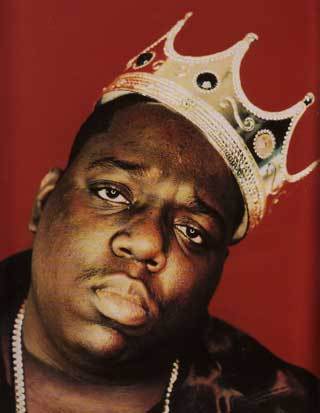
No doubt Notorius B.I.G., aka Biggie Smalls, aka Christopher George Latore Wallace was one of the most influential figures in rap history, let alone one of the biggest (figuratively and literally) musicians of the nineties, but I, for one, think Biggie deserves a little more than that.
On the other hand, Notorious B.I.G. was a legacy, a controversial figure who ascended from the streets only to wind up crashing in his prime. The story writes itself, no? I didn't have a chance to delve into his music lifestyle at the time it came out (owing to me being too young and too, well, pigmentally challenged.) However, I did have a chance to listen to most of "Life after Death" on a car ride to Brooklyn on a film shoot. In total, Biggie Smalls is an image, a part of time and a place that only comes around once; it was inevitable that he get a movie sooner or later. So, what better place to see it than in Brooklyn?
My first indication of the effect of this film was the presence of PO at the door. My first instincts were only confirmed when I got to the theater. Even though I arrived about a half an hour early, I had to sit in the neck-breaking seats in the very front. As one movie-goer put it, "some good-ass seats."
After a mind-numbing 3 Doors Down National Guard commercial that made me forget what good music sounds like, the "Notorious" Experience began.
What I'm about to write next may be a major spoiler for some of you, but it's more of a statement of fact. The movie starts with, well; to put it bluntly (cough cough,) Biggie gets shot. In one moment, my expectations went down the drain like yesterdays bath water. I had naïvely hoped, in my film-critic's optimism, that George Tillman Jr. and Sean P. Combs could put together something totally original in this age of carbon-copy music biopics.
It seems like at some future date, no matter what genre or artist you are into, there will be a biopic for you. Before I continue with this review, I'll take a moment to spell out the basic formula: young, disillusioned artist is an outcast; he finds music as a channel for his talents and quickly becomes popular; as his star rises, he goes out, screws a lot of women, has a bunch of babies, and does tons of drugs. Finally, he crashes, loses everything, and has to find himself again, either through spirituality, the music, or more drugs and sex.
And, "Notorious" is no exception. If you've seen "Ray," "Walk the Line," "Sid and Nancy," or even, "Walk Hard, The Dewey Cox Story," you've got the basic gist of what happens. Except, in Notorious there are a lot more swearing and titties. I was even waiting for someone to say, "he needs more blankets and less blankets at the same time!"
By the way, Lil' Kim gets all sorts of naked in this move, which no-one has a problem with. (Well, as long as it's not actually her.)
What perturbed me about this film was the handling of the transitions; some scenes would cut through literally years without any explanation. In one cut, Biggie suddenly has another kid. Sometimes it works, however. For example, Biggie goes from talking to Lil' Kim (Naturi Naughton, more like, Naturi HOTton (bad joke,)) to gettin' it ON in one brilliant cut.
To be fair, everyone put in a great performance in this film. Jamal Woolard was thoroughly convincing as the legendary B.I.G. Angela Basset also delivered. Some parts, which weren't over the top or formulaic, were incredibly touching and deep. In one scene, a friend from the streets, who went to jail rather than allow Biggie to sacrifice his burgeoning career, returns to console an ailing Smalls in the hospital after his accident.
But for every place where is shines, "Notorious" falls just as hard. Some of the dialogue was extremely contrived, as if the idea was, "Let's give Biggie the most ghetto thing to say." When informed of his first child, T'Yanna, Smalls responds, "Damn." Also, the whole East-Coast West-Coast rivalry was handled EXTREMELY gingerly, avoiding taking sides at all costs, and defending Biggie's claim at the same time.
Tupac and B.I.G. were portrayed as, if I may insert a white-ism, "bro's." Then, after the 1994 shooting happens, the whole dynamic does a one-eighty. I'm perfectly willing to admit that I'm not the most qualified person to examine hip-hop history (say that three times fast, G,) but it seems to me there's much more to it that what was put on the screen. Moreover, some of the way the material was handled was (for me) a bit tame. If you listen to Biggie's music, he talks about some sick shit. These were people who DID come from the streets, who did deal and struggle and commit various crimes, something which is lost on a polished movie set. It's not enough to throw around the F-word and show some fantastic breasts; everything you hear on a street corner in Brooklyn, for instance, ain't gonna make it up on the B.I.G. Screen. Word.
I guess the final nagging point that I'm hammering away at here is this: Biggie Smalls was such an interesting person and lead such an interesting life that his biopic practically writes itself. Moreover, relying on formulas to tell stories, especially those that could be better told without, is one of my core gripes with Hollywood. It gets to the point where you can set your watch to dramatic events.
Or maybe I'm whipping a dead horse.
So, if you like music biopics, and you like Biggie, "Notorious" is the movie for you. If you don't like music and you don't like movies, then you should probably get out more.
One final note: the fact that Puff Daddy (or Sean "Diddy," or P. Diddy, or Poo Doodley, or whatever he wants to call himself nowadays) did not appear in the movie, but only executive produced it endears me to him just a little bit.
It's just a matter of time before we see the Tupac movie.
Schrader out.