June 29, 2008

Asian American International Film Festival


The AAIFF, sponsored by the Asian Society and Asian Cinevision, will begin starting July 10th until July 19th. 

There seems to be many interesting films being screened this year so if you are interested, click here for the full program.

June 21, 2008

NAKADAI and NOGAMI

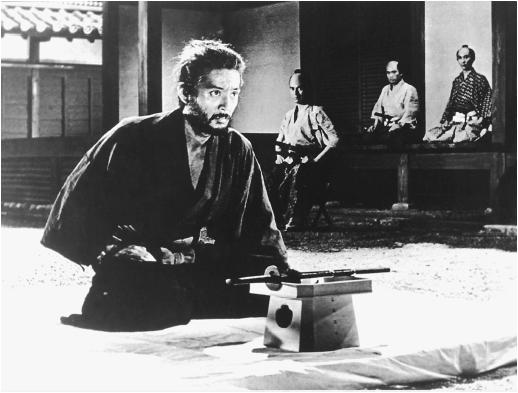
Yesterday, Taylor and I went to go see Seppuku (Harakiri) at the Film Forum, which was followed by a Q&A session with the star of the film, Tatsuya Nakadai. There were many great questions. I can't remember all of them but here are a few:

Q:"How much of the film was improvised/ad lib and how much was it scripted?"

A: "Everything was scripted. None of it was improvised."


Q: "How do you feel about the messages of Harakiri?"

A: "Concerning bushido and authority, I feel that every individual should be free to choose how one lives. When I was brought up, I was told that we must give our lives to the Emperor, which of course is not the case today. Nowadays, we are all free to choose how we think which is a great thing."


Q: "How was the film received in Japan?"

A: "The film met with a decent amount of praise in Japan, but the funniest part was at Cannes. During the screening, apparently, at least 10 french ladies fainted at the harakiri scene and so the director and I thought that the film was doomed. However, after the screening, we were met with so much praise that the Japanese media thought that we would win the Grand Prix. I specifically remember going to several interviews being asked how I felt about winning the Grand Prix when the winner wasn't even announced yet. In the end, Luchino Visconti's The Leopard, ended up winning it. At the dinner party, I saw Visconti and Alain Delon celebrating at the other table and we were sort of huddling together in jealousy at our table. It was quite funny."


I also had the great opportunity to ask my own question:
"So I heard a story that during the shooting for this film that you and Rentaro Mikuni had an argument regarding projection of voice. Mikuni, being a film actor, argued that he didn't need to speak loud because the mic was right in front of him but you, being from theatre, argued that you can't respond if you can't hear his lines. Director, Masaki Kobayashi, finally stepped in and stopped shooting for 3 days until you two came to a resolution. Is that true?"

A:"That is absolutely true. During the scenes where we are speaking, the distance was just like where you and I are standing (app. 20 ft.) so it was difficult for me to hear him if he didn't speak loudly. We got into an argument and so the director told us to resolve our conflict and stopped shooting for three days. I can't imagine that happening today in the U.S., or in Japan for that matter, but back then we had lots of time to spare."


So apparently, my question was pretty interesting and a man from the Japan Foundation pulled me to the side and gave me an invitation to a special screening of Ran followed by a reception with Nakadai and Nogami, which was to be held the next day.

Before the screening, however, Nakadai and Nogami visited the Japanese bookstore, Kinokunia (located across the street from Bryant Park), for a book signing. 

Mr. Nakadai signing my Criterion DVD inserts for Harakiri and Ran.


Ms. Nogami signing my copy of her book. She's drawing the Seven Samurai flag t-shirt I was wearing today (or rather yesterday seeing that's it's 1 AM)

After the book signing, I hurried off to the Japan Society and saw Ran again and was blown away. It's really something to see on the big screen. Mr. Nakadai said a few words after the show and then we hurried on to the reception.

Ms. Nogami and I at the reception following Ran.


Mr. Nakadai and I.

Well there are two more chances that I'll see them. One on Tuesday for Nakadai's lecture at 8:20 PM at the Film Forum, and one the next day for Nogami's lecture at 6:30 at the Japan Society. I don't know if tickets are still available but if they are, you should definitely go and check them out!!

June 11, 2008

50 Years with Akira Kurosawa

Legendary director, Akira Kurosawa's, script supervisor will be coming to New York City on Wednesday the 25th of June to lecture about Kurosawa and the inner workings of his creative mind. Nogami stood by Kurosawa from Rashomon to Madadayo and has been through the ups as well as the downs with the master filmmaker. It's definitely worth checking out and a must if you are a Kurosawa fan.


Nogami on the far right with actor Toshiro Mifune
in the middle and Kurosawa at the bottom.

June 6, 2008

Werner Herzog in NYC


Today, I had the great privilege of seeing Jonathan Demme interview Werner Herzog at the Times Center. Demme has created many great movies including the classic Silence of the Lambs and Philadelphia which both won oscars. Herzog is an international phenomena, who has made the legendary Aguirre, the Wrath of God and has recently finished his documentary, Encounters at the End of the World. 

To give you a little sense of what Herzog's past was like, he grew up in the remote mountains of Bavaria, Germany and saw no film, TV, or radio during his childhood. He started traveling on foot at the age of 14 and made his first film when he was 19 (by stealing a camera). Despite this, he is one of the most interesting (and great) filmmakers today.

Like the Gondry interview, I did record the whole conversation so if anybody is interested, please let me know. 

Demme and Herzog started out by discussing a letter Roger Ebert has sent to Herzog expressing his admiration toward his works (which could be found on Ebert's site), then transitioned into some aspects of Aguirre, particularly the river scene after the people descend the mountain. Herzog explained how he had his DP hold the shot of the river to get a sense of the rage and anger of the water, which will ultimately be the demise of the soldiers. He also talked about filmmaking in general and his take on sound in his films. He also went on to speak about various other things (such as his relationship with Rainer Werner Fassbinder) but what I found the most interesting was when he talked about what makes a filmmaker. 

"You have to know the heart of men. If you don't, you are not a filmmaker". 
-Werner Herzog

I think that's very true, especially for young student filmmakers, like myself, who may get too absorbed in the technical aspects that they forget what is most important: the connection with the audience. I could be speaking for myself, but sometimes I feel that I lose that connection with people or I'm not connecting enough. I don't know if everybody knows the "heart of men" but I think it's something many filmmakers (or at least I) should be aware of. 

On a different note, some of you may have already heard the news but two guys climbed the New York Times building today. Right before the Herzog interview, I was waiting for my good friend Nestor, when spider-man started scaling the wall in front of my eyes. It was quite a feat.


Crazy things happen when Herzog is around...

June 1, 2008

While we're still on the topic...

Professor Ramin Bahrani was featured again, this time on a bi-weekly podcast I listen to called "filmschool". They interview independent filmmakers and various indie festival officials about the making of their films and some significant news in the industry. You can listen to the podcast by subscribing to it on iTunes or you can download the Bahrani episode by clicking here.

They also interviewed Hunter alumnus director Guy Moshe about his first film Holly. That could be downloaded here.

May 20, 2008

Bahrani's Favorite Criterions

Professor Ramin Bahrani of Hunter College shared some of his favorite Criterion Collection DVDs in the most recent newsletter. If I remember correctly, last semester he taught screenwriting. Anyway, check it out:

My Top Ten Criterions*
Ramin Bahrani
Writer-director Ramin Bahrani’s first two feature films, Man Push Cart (2005) and Chop Shop (2007) have won awards and acclaim all over the world, from Venice to Cannes to the U.S. Chop Shop also won Bahrani the Someone to Watch Independent Spirit Award in 2008. Bahrani is currently in postproduction on his third feature, Goodbye Solo.


1. Nanook of the North Robert Flaherty
Robert Flaherty set his camera down and had the audacity and humanity to step back. I like Man of Aran even better. Without these films there would not have been La terra trema, Rome Open City, Bicycle Thieves, Where Is the Friend’s House?, Il posto . . . Such simple and moving storytelling, and so profoundly in touch with what it means to be human in this world. He has forever erased the line between fiction and documentary. What is left, fabricated or not, is a visual poem that challenges how we live and how we see, and all the while accepting life for what it is.


2. Mama Roma Pier Paolo Pasolini
Pasolini was murdered for a reason: he was a real artist with something to say that too many people did not want to hear. Nobody brings as much love and anger, and challenges and questions, as PPP. His films explode with life and energy, politics, religion, doubt, devotion, humor, and irony, and force you to rethink everything in your life and outside your life. Each frame is a revolution and a dare to the viewer. Bertolucci said, “You can tell when Pasolini puts the pen down and picks up the camera.” Which other filmmakers can claim that this quote would be true of them? A devastating majority of films are just filmed screenplays. Pasolini belongs to the rare group of artists who make films. Empty yourself, wash your eyes and ears, and for the first time really watch and listen to what the master has to say.


3. The Flowers of St. Francis Roberto Rossellini 
My favorite from Rossellini. A sublime call to us all to be good, even at our own expense. Ten times more subversive and inspiring than any in the long list of meaningless yet much-lauded films made about the “lessons” of war, injustice, and inhumanity. This is the film everyone should have been watching in the last eight years. Fellini’s humor and Rossellini’s ironic wit are at their very best here. The monks are brilliant in their roles. A must-see gem.


4. Il posto Ermanno Olmi
A great Italian film from the often ignored Olmi (please also see The Tree of Wooden Clogs). The scenes between young Domenico and Antonietta are so real you will think you have witnessed them yourself while standing outside a café window. Wonderful mix of humor and sadness, and of lightness in the face of the eternal meaninglessness of society’s damning labyrinth. The scenes go by so effortlessly, yet by the end you’re profoundly moved without understanding how Olmi has done it.


5. Umberto D. Vittorio De Sica
I first saw this as a college student at one of the city’s repertory cinemas, in the early nineties, and will never forget it. One of the most simple and moving films ever made about man not losing his dignity in the face of our eternal fate and society’s greed. How to stay alive and human when you are no longer useful to our indifferent world? How to maintain hope when all that is left is to turn into the dust from which we came?


6. L’avventura Michelanglo Antonini
Every director should have a respect for the frame, and here Antonioni reminds us of that lesson shot after shot. He shocked Cannes but without being exploitative, which is more than most enfants terribles in Cannes’ history can claim. Antonioni shocked by being a ruefully disturbing mirror into the souls of his generation. Sandro’s empty desires, and Claudia’s blind and desperate search for meaning and connection in the deadly silence of life, are as true to our times as to when the film was made. Monica Vitti astounds with her beauty and her mystery, and Antonioni’s courage to explain nothing but allow us to feel and question everything is a testament to his brilliance.


7. Au hasard Balthazar Robert Bresson 
One lesson after another from the master to all his students. A film that makes you ashamed to be part of the human race, and then fills you with the courage to be better.


8. Scenes from a Marriage (full TV version) Ingmar Bergman
A great first-date movie! Well . . . perhaps not. I have never seen a more truthful and honest account of human relationships. Shockingly simple in its creation, once again proving how hard it is to be simple and how it is usually much more profound. Bergman keeps cutting away to reveal more, not less. He has done the difficult and dirty work for us. Watch and accept the truth about our relationships, and then, like all of mankind, try to avoid your fate.


9. Nights of Cabria Federico Fellini 
Along with La dolce vita and I vitelloni, my favorite from Fellini. So much love and hope in the face of the bastards who seem to run this world. Masina is brilliant and PPP’s dialogues and understanding of the “wretched of the earth” are perhaps Fellini’s good karma for the gifts he brought Rossellini in The Flowers of St. Francis seven years prior. Daring, loving, and painful. Thank you for not ending this one at the sea, but instead on the road, with trees, music, tears, and smiles—a real carnival in the face of death.


10. Seven Samurai Akira Kurosawa
Lessons one through one hundred in how to write, shoot, direct, and edit a film. Sit down and enjoy.

*Taken from the Criterion Collection Website

May 18, 2008

31st Annual Hunter Film Festival Results

The Film and Media Society of Hunter College hosted the 31st Annual Hunter College Film Festival last weekend which screened many different and interesting films. The categories were documentary, production 1, production 2, produced on video, cinematography, and production seminar with a total of approximately 25 films.

Here are the results:

DOCUMENTARY:
STREET SUPREME - dir. MICAH BOCHART

PRODUCTION 1:
TELEVATORS - dir. NATHAN SCHRADER

PRODUCTION 2:
DISCONNECTED - dir. AMIR ADELAR MINDER

PRODUCED ON VIDEO:
SLEEP WALKER - dir. DAIGORO HIRAHATA


EXPERIMENTAL:
"CHARLIE ROSE" BY SAMUEL BECKETT - dir. ANDREW FILIPPONE JR.

CINEMATOGRAPHY:
ANDREW'S GUN - dir. TERESA SONEBORG

There were also a few seminar films but sadly I do not remember all the director's names. My program was used as a voting sheet.

SEMINAR:
KILL ME A SON - WINNER

TATI FROM 4 TO 7

UNKNOWN MELODY

DIONAEA

May 13, 2008

Tatsuya Nakadai in NYC


Daigoro brought this to my attention.

Tatsuya Nakadai is visiting the city for a retrospective and talk back at the Film Forum, a signing at the Bryant Park Kinokuniya book store and other events.

Nakadai is a truly great actor and has an impressive list of credits.He has had starring roles in Kobayashi's Harakiri and The Human Condition as well as more recent works like Kurosawa's Kagemusha and Ran. He's worked with other greats like Teshigahara and Imamura too.

He is a highly visible presence and has carried equally memorable supporting roles. A favorite of mine that comes to mind is the smirking, gun wielding baddie from Yojimbo

The retrospective starts in late June and continues through July, ending with a three week run of The Human Condition.

Check out the Film Forum site for more details and info on other events.

May 12, 2008

A Little Late but...

I wanted to let people know what's been going on recently.


I know it's incredibly last minute but the 31st Annual Hunter College Film Festival is coming up this week on Friday at 3 pm-ish and Saturday "Selects" at 6 pm. If you would like to submit your work, it's due this Wednesday by 4 pm in the drop off box in the Film and Media Office at 433HN. They are also looking for volunteers so if you can, please contact Ruomi Hampel at ruomi@hotmail.com.

On a different note, last Friday I had the wonderful opportunity to go see Michel Gondry speak at the Times Center. Excluding myself, there were about 6 other Hunter students who also went. I sat up front as he spoke about his music videos (Bjork, The White Stripes, and The Rolling Stones in particular) and about his 5 feature films (Human Nature, Eternal Sunshine, Science of Sleep, Be Kind Rewind, and Dave Chappelle's Block Party). He told some interesting anecdotes about stuff that happened during filming and his influences for his film concepts. He also spoke a little about the importance of scripts. Unfortunately, we ran out of time and we couldn't ask any questions directly but it was overall a very interesting and fun experience. We got a very personal look at Gondry as well as a little glimpse into his creative mind. I recorded the whole conversation so if anybody is interested, I could give them a copy. I must warn you though that his french accent is pretty hard to understand at times, especially through a recording.


According to a friend, she said that when Wong Kar-Wai came to NY, there was a 45 minute Q&A session afterwards so there is a good chance that that will occur in future guest speakers. If you didn't already, you should probably reserve your tickets for Werner Herzog. Get them here.

May 4, 2008

50 Years of Janus Films: Episode I


Александр Невский (Alexander Nevsky)
Sergei Eisenstein, 1938


Great art is a reflection of the times; great propaganda, a reflection of the minds of that time. Many would not associate propaganda with art, but the films Sergei Eisenstein produced for the Soviet government from 1917 until his death in 1948 can be called nothing less. The ulterior motive of this Stalinist epic is brutally clear; foreign invasion must be stopped at all costs. But the stunning visuals, storytelling, and composition of this film, along with the incomparable soundtrack by Sergei Prokofiev (a must for every hardcore film buff,) hint at a greater work which transcends the party message.

Lenin once said film is the media of the masses, it was in this spirit that Soviet filmmaking took off in the late '10's and early '20's of the past century. Borrowing techniques from American and European filmmakers, the Russian school of film pioneered new methods of editing and montage to convey visual tapestries of emotion. Eisenstein, creator of the silent masterpiece "Battleship Potemkin," worked with a style called "intellectual montage," in which the framing, juxtaposition, and composition of scenes create an emotional and aesthetic tapestry of meaning. This is particularly apparent in the scenes at the Teutonic Knights' camp in which the Catholic mass is made to look almost like a Nazi rally, complete with Iron Crosses and a symbol which looks strikingly like a swastika. This is also clear in scenes of pastoral Russia, in which the low angle of framing emphasizes the space and sheer magnitude of the land, and the unity and singularity of the people.

Before getting into the nitty-gritty, a bit of history; Alexander Yaroslavich Nevsky was the grand prince of Novgorod and Vladimir in the 13th century. He defeated the Swedes at the battle on the Neva, giving him the name "Nevsky" from the river. The action of the film concentrates on his routing of the Livonian Knights (in the film, called "Teutonic Knights," or "Germans") on Lake Peipus. However, all this leads me to feel like I'm working on my Russian History paper, which I should be doing.

In the film, Alexander Nevsky leads an army of Russian peasants against the fearsome German invaders. Here is where the polities of the time are most clear, the Catholic Germans represent the two greatest enemies to Stalin's state: Religion, and Hitler's Germany. Fearsome is right, as we bear witness to German Knights hanging civilians and throwing babies into a fire.

The film opens as Alexander Nevsky, played by Nikolai Cherkasov (whom you may have seen as the title character in "Ivan the Terrible,") has left politics to live as a simple fisher on the river of his namesake. Meanwhile, the teutons invade neighboring Pskov and massacre its people. The call goes out to summon Alexander Nevsky, who raises an army of peasants and goes to meet the teutonic knights in battle on the frozen lake Pleshcheevo.

Like most epics of Soviet Realism, the film is extremely black and white; the German teutons are evil, Alexander and the Russians are good. They battle, good triumphs over evil. But it is the craft-work of the film; the editing and composition, specifically in the battle sequence, are an historical contribution to filmmaking. Keep in mind this film was made in 1938, years before war epics like Ben Hur and Spartacus. The scene on the ice after the battle, in which dirges are sung for the dead and dying, is one of the most poignant and touching scenes to date.

The film also differs from most pictures in the Soviet Union at the time, which focused more on nationalistic issues than those of foreign policy. Although Russia and Germany were still technically "allies" at the time the film was made, it alludes to German invasion, which occurred in 1939. What followed in the war period was a lull in Soviet filmmaking, understandable in light of the enormous horrors and privations Russia faced at the hands of the Nazis. Ultimately the Soviet Union triumphed over the forces of fascism, thanks in no small part to the spirit created by works like "Alexander Nevsky." It begs the question, how useful is art in matters of national importance?

Next Episode: "Popiół i diament" (Ashes and Diamonds), 1958, Andrzej Wajda.

Peace,
Nathan Schrader